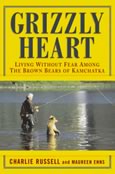
Grizzly Heart: Living Without Fear Among the Brown Bears of Kamchatka by Charlie Russell and Maureen Enns
– available at Polar Peek Books & Treasures in Fernie
– Reviewed by Angie Abdou for The Fernie Fix’s October 2009 Issue
 To be honest, I expected Charlie Russell to be a bit crazy. Until this summer, I only knew him by reputation. He was, I’d heard, a man who not only lived amongst bears, but had also been known to fish with bears, hug bears, wrestle with bears, and occasionally stick his hand right into the mouth of a bear. I’m terrified of bears, so in my mind one word captured Russell’s reported behaviour: cuckoo! To be honest, I expected Charlie Russell to be a bit crazy. Until this summer, I only knew him by reputation. He was, I’d heard, a man who not only lived amongst bears, but had also been known to fish with bears, hug bears, wrestle with bears, and occasionally stick his hand right into the mouth of a bear. I’m terrified of bears, so in my mind one word captured Russell’s reported behaviour: cuckoo!
In July, however, I had the opportunity to meet Charlie Russell. Thanks to Island Lake Lodge and The Fernie Gateway Project, I was treated to an interpretative hike though the Lodge’s stunning bear habitat (including a very close look at an inactive bear den) and then a five-star dinner with Charlie Russell himself. Within fifteen minutes of meeting the Bear Man of Kamchatka, I was converted. Charlie Russell is not crazy at all – he’s a true student of nature, one who approaches the wild world with awe, reverence and respect. He has spent his life challenging our culture’s (and our scientists’) biases towards bears. One cannot help but admire Russell’s brave eagerness to learn about bears from only bears themselves.
In the spine-chilling prologue of Grizzly Heart, Russell outlines the incident that transformed his interest in bears to a life-long calling. Based on his startling relationship with one particular bear in Northern British Columbia, Russell began to suspect that bears were only aggressive and unpredictable because they had been so badly treated by humans. He postulated that if a bear only knew love from humans, then that bear would have no reason to act violently towards humans. To test this theory, Russell had to find a location with a very large bear population and a very small human population.
Grizzly Heart chronicles Russell’s experiment living with the grizzlies on Russia’s Kamchatka Peninsula. He and his then partner, artist Maureen Enns, set off for Russia with the ambitious goal of shifting human perception so that “people might learn to live with bears in a way that would not lead to collision, violence, and the ongoing destruction of a threatened species.” Russell believed it was time to work out a truce between grizzlies and humans, and his hypothesis was that “human fear was the true obstacle to coexistence.”
Russell himself insists repeatedly that he is not a scientist, and his method is often bold-facedly unscientific. He approaches the bears more like a sociologist than a biologist, and his book reads more like action adventure than scientific treatise. Russell’s arguments about the short-comings of modern science are intriguing. The main difference Russell sees between his approach and the scientific method is the “open-mindedness and capacity for wonder” that he brings to his work.
I have to admit to being uninterested in the book’s discussion of logistics surrounding the Kamchatka project. My attention wanes when Russell slows the pace to outline the details of funding and travel and housing. Even that flagging interest, though, marks a success of the book. I was only two chapters deep and already I’d lost interest in boring humans and their boring problems. I wanted only the awe-filled passages describing Russell’s peaceful and even playful interaction with these wondrous bears.
Russell asks us to consider the power of human language and the way in which it has been used against these beautiful creatures. He relays how hunting guides “tell one horrifying story after another about people being torn apart” and then “recount countless acts of sportsmen bravery” – all with the goal of making clients feel “tremendously powerful” when they finally do kill a bear. He complains of much of the vocabulary surrounding our treatment of bears, especially the use of “harvest” to refer to a bear hunt: “I can’t imagine using that word as a synonym for killing an animal you actually care about.” We need new stories and new vocabulary to reshape the way we live with these animals. Grizzly Heart provides both.
I now keep a copy of Grizzly Heart on my coffee table. It’s not a book to stash away in a bookshelf to collect dust. When conversation turns to the ubiquitous bear horror stories, I want Grizzly Heart on hand so I can share Charlie Russell’s hypothesis (as well as the protocol outlined in his conclusion). More importantly, I want to show the mind-boggling pictures scattered throughout the book – pictures of Russell cuddling with bears, locking hands with them, petting their noses.
Those pictures alone are worth Grizzly Heart’s cover price.
–
Angie Abdou is a local writer. Her first novel, The Bone Cage, was chosen by Kootenay Library Federation for its 2009 “One Book One Kootenay” celebrations. She will be touring the East and West Kootenays throughout September and October. For more information, see this website.
|