Tide Road by Valerie Compton & Kalila by Rosemary Nixon
– both books are available at Polar Peek Books & Treasures and will also be for sale at the Fernie Heritage Library when the authors visit Fernie early this month.
– Reviewed by Angie Abdou for The Fernie Fix’s February 2012 Issue
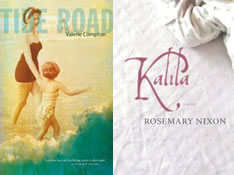 On February 6th Valerie Compton and Rosemary Nixon will be speaking at the Fernie Heritage Library about their recently released books: acclaimed novels that also work as emotionally heightened meditations on motherhood and loss. On February 6th Valerie Compton and Rosemary Nixon will be speaking at the Fernie Heritage Library about their recently released books: acclaimed novels that also work as emotionally heightened meditations on motherhood and loss.
In Tide Road, the narrator, a lighthouse keeper named Sonia, comes to terms with some dark spots in her personal history. Through a series of choices that don’t feel like choices, Sonia finds herself in the roles of wife and mother in the mid-1940s. Decades later, she attempts to piece together her fragmented and repressed history in the face of the tragic—and potentially criminal—disappearance of her adult daughter, Stella. As boats dredge the river’s bottom for Sonia’s troubled firstborn, Sonia dredges her memory, nearly drowning in her own guilt. She realizes she has set in motion a multi-generational pattern of domestic abuse and what we might (or might not) label post-partum depression.
In this narrative, blame, guilt, and a sense of failure seem inextricably linked with motherhood. The maternal life is also rather closely associated with self-sacrifice, unhappiness, annihilating obligation, and fear. Thematically, Compton’s work reminds me of the feminist poetry of Dorothy Livesay. Like Livesay, Compton is brutally and bravely honest about the things a woman, particularly a woman artist, must sacrifice in the name of motherhood.
This overview makes Tide Road sound dark to the point of despair. It is not.
Remember, there is after all a lighthouse. There are bifocals. There is one extremely alluring optometrist. There is light; Sonia simply has to learn how to see it. Only by allowing herself to accept the help of others can she begin to see what is – and has all along been – right in front of her.
Through Sonia’s quest to come to terms with her daughter’s disappearance, Tide Road makes it clear that to be alive is to fear loss, a fear that is intensified when one has children. Eventually, Sonia, however slowly and imperfectly, learns the trick of living in the moment and thereby finding happiness in spite of inevitable loss.
Seeing and loss are also a central themes in Kalila. The book opens with these lines: "The news is like staring into an eclipse of the sun. Look at it straight and you’ll go blind." Like Tide Road, Kalila asks readers to look long and hard at something that is painful, something nobody wants to see. The next lines read: "You prepared. You prepared for a child to be born. You have not prepared for this."
Kalila is set largely in a Neonatal ward. The first page made my breathing hitch. I’m sure my heart stopped for a moment. Three times I picked up the book to start and put it right back down again: I cannot read this, I thought. On the fourth time, I pushed through that initial resistance and read the whole novel in a single day.
Nixon has done a courageous thing. She has spent fifteen years writing a book that people won’t want to read: a book about sick babies. A book about a world in which this piece of dialogue makes sense, "No, you don’t have to hold him. No, some mothers choose not to."
Put all expectations and preconceptions aside. Kalila is a profoundly beautiful novel, a startling and original mix of physics and poetry that celebrates life as much as mourns it.
In both novels, mothers learn to live with loss. They also learn that their daughters will always be with them. In Tide Road, the mother’s life is made from the daughter’s life "the way a wave is made of sea." In Kalila, the grief-stricken mother discovers that "a baby leaves some of the X chromosomes behind in the mother’s body when she’s born [….] A mother carries her child forever."
I loved both of these novels and applaud the authors for their candour and the risks they have taken. I am excited to host them here in Fernie in February. The library panel discussion will focus on the theme of motherhood and loss. We will also talk about what fiction lends to such discussions. What can novels contribute to our understanding of motherhood and death that self-help books, memoirs, or other nonfiction treatments cannot? Come meet the authors and share in the discussion: February 6th, 7pm, Fernie Heritage Library.
–
Angie Abdou is a local writer. Her most recent novel, The Canterbury Trail, was a finalist for the 2011 Banff Mountain Book of the Year and a Canadian Bookshelf Best Book of 2011. Her first novel, The Bone Cage, is the MacEwan Book of the Year; at the end of February, she will travel to Edmonton for a week of book festivities at MacEwan University.
|