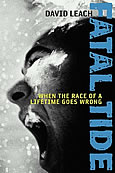
Fatal Tide by David Leach
– Reviewed by Angie Abdou for The Fernie Fix’s October 2008 Issue
Buy this book from Amazon.ca 
 In the acknowledgements at the back of Fatal Tide, David Leach thanks Canada Council for giving him a grant early in his writing career that allowed him to discover that he’s a better journalist than a novelist. Because I habitually read the acknowledgements before reading the rest of a book, I spent much of Fatal Tide thinking about the different challenges involved in writing fiction and nonfiction. Before we even open the cover of Leach’s nonfiction book, we know not only what the book is about but also exactly what happens. The narrative can be easily summarized: Some neophyte organizers—Sarah Vlug and Jayme Frank—host a “beginner” adventure race that involves a kayaking leg in the Bay of Fundy. A sudden storm sweeps the coast. Many racers run into trouble. René Araseneault—a young amateur athlete competing in his first adventure race—dies. We also know the key issue (i.e. what risks are reasonable in the name of sport?), and we probably already have a pretty good idea of where we stand on this issue. Leach thus has to make do without one of a novelist’s key tools: suspense. What, I wondered, was going to hold my attention through 255 pages of narrative when I didn’t have unanswered questions to keep me reading? Why would I bother finishing a book when I already knew the exact fate of the main character? In the acknowledgements at the back of Fatal Tide, David Leach thanks Canada Council for giving him a grant early in his writing career that allowed him to discover that he’s a better journalist than a novelist. Because I habitually read the acknowledgements before reading the rest of a book, I spent much of Fatal Tide thinking about the different challenges involved in writing fiction and nonfiction. Before we even open the cover of Leach’s nonfiction book, we know not only what the book is about but also exactly what happens. The narrative can be easily summarized: Some neophyte organizers—Sarah Vlug and Jayme Frank—host a “beginner” adventure race that involves a kayaking leg in the Bay of Fundy. A sudden storm sweeps the coast. Many racers run into trouble. René Araseneault—a young amateur athlete competing in his first adventure race—dies. We also know the key issue (i.e. what risks are reasonable in the name of sport?), and we probably already have a pretty good idea of where we stand on this issue. Leach thus has to make do without one of a novelist’s key tools: suspense. What, I wondered, was going to hold my attention through 255 pages of narrative when I didn’t have unanswered questions to keep me reading? Why would I bother finishing a book when I already knew the exact fate of the main character?
Simply put, the answer is: good writing. Extraordinarily strong writing ensured that my attention was gripped by every single word. As English professors across the globe will insist, good writing is in the details, and Leach’s book is packed full of vivid and well-researched details. Instead of relying on suspense, Leach creates momentum by opening up an old issue, personalizing it, and making us see it anew.
The scope of Fatal Tide is vast. Leach’s analysis of the René Arseneault tragedy incorporates elements of anthropology, psychology, biology, and sociology to draw conclusions about the psychology of risk and to lead readers to revaluate their own opinions about extreme sport. The research in this study is so thorough and extensive that I can’t help suspect that Leach has a capacity for endurance and an ability to focus to the point of obsession that would rival that of the extreme athletes who are his research subjects.
In terms of sub-genre, this book falls more toward investigative journalism than it does toward creative non-fiction. However, the journalistic stance and the rigorous research—which even goes into tremendous detail about the science of hypothermia—do not make for a dry read. On the contrary, Leach has such a knack for characterization that we are pulled into this book with a level of emotional involvement that I’ve only encountered in the best of novels.
I can guarantee that no parent will be able to keep dry eyes during the hospital scene where René’s mother first views her son laying on a stainless steel gurney with his eyes taped shut. Even after being warned of the emotional intensity of the post-race passages by both my husband, Marty Hafke, and my one-man-writing-group, Nic Milligan, I was still daft enough to read Fatal Tide in public. I sobbed through three full chapters. When Sarah Vlug, the race organizer, complains to reporters of being completely emotionally drained, I empathize. Fully. Leach’s writing here is at its most powerful. Whether readers want to be or not, they are there, in the midst of the crisis, in the heart of the tragedy. This intensity carries right through the post-race investigation in which an entire community finds itself on trial and nobody seems to be exempt from blame.
In the course of the book, Leach considers many extreme sports with a Fernie connection. He specifically discusses The TransRockies, and he also poses some pertinent questions about free-skiing competitions. In the controversy following Arseneault’s death, Leach tells us that “most insiders agreed that it had only been a matter of time before someone died.” Of course, the same has been said—with equal prophetic force—of extreme skiing events. In the wake of this book, readers will be forced to wonder: is this a risk that we—as skiers, as parents, as friends, as a community—are willing to take? If your answer is an uncomplicated “Yes!” you would do well to read Fatal Tide for a fuller understanding of the issues from many angles. If your answer is less affirmative or less emphatic, well … read Fatal Tide anyway. It’s good. And, it’ll make you think, which is exactly what all worthwhile books should do.
* * *
–
Angie Abdou is a local writer and college professor. She has published a book of short stories (Anything Boys Can Do) and a novel (The Bone Cage). Currently, she’s hard at work on a novel about ski bums
|