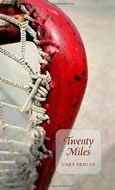
 Twenty Miles by Cara Hedley Twenty Miles by Cara Hedley
– Remember: always support your independent bookseller. Love it or lose it.
– Reviewed by Angie Abdou for The Fernie Fix’s May 2012 Issue
I write this column as I fly home from Burlington, Vermont where I attended The Face of the Game, a symposium held in conjunction with the Women’s Hockey World Championships at the University of Vermont. The panel on which I participated focused on representations of women in hockey literature, and my own discussion centred on Cara Hedley’s Twenty Miles, the first Canadian novel to feature women’s hockey.
Rereading this novel in preparation for the panel, I realized that there is a lot a writer can take for granted when focusing on hockey played by men. Writers like Bill Gaston or Paul Quarrington don’t have to address the fundamental question of what it means to be a male hockey player in Canada. In Canada that would be like asking what winter means. What kind of stupid question is that? Winter is winter! Hockey is hockey! The ubiquitous nature of men’s hockey in Canada leaves writers like Gaston or Quarrington free to use hockey as a metaphor or vehicle to discuss other issues (aging, story-telling, memory, father-son relationships, sacrifice, fame).
In contrast, as the first Canadian novel about women’s hockey, Twenty Miles does ask this fundamental question: what does it mean to be a woman hockey player? The novel’s protagonist is Isabel Norris, who has just left home to play for the fictional Winnipeg University Scarlets. Iz, as she’s known by her teammates, was raised by her grandmother Sig after the death of her hockey star father. Throughout the novel, Iz is "skating against a ghost." Strangers tell her she has her father’s hands. She confesses she feels she is playing in his skates. Hockey is her father’s story, and she can only play it in his shadow.
The anxiety of this influence, of course, functions metaphorically. All the girls are playing their fathers’ game, and the challenge is to eke out their own place, claim hockey as their sport, and stake their rightful place at centre ice. At the start of Twenty Miles, there is a very rigid gender division: masculine and black-skates and hockey versus feminine and white-skates and figure skating. To play hockey, the girls must choose the masculine side of that divide. They have to learn to "take it like a man" and prove that they have "balls of steel." Each adopts a male nickname and is embarrassed of her "girl’s name." They show great contempt for the feminine figure skating team, who they call "the finger painters." They perceive that girl-sport’s exaggerated femininity as a sign of weakness. The female hockey players seem uncomfortable with any behaviour traditionally marked as feminine. When their team captain’s mother becomes sick, they do cook dishes for her and engage in nurturing behaviour, but they do so awkwardly and on the sly. Yet they never quite seem comfortable with their masculine behaviour and discourse either – it’s always a performance. Iz’s challenge comes in creating an identity for herself within hockey, one that extends beyond this rigid, essentialist gender division and beyond her father. She must carve her own place in the game. The novel thus marks an important moment in women’s hockey programs and in the history of women’s sport. Twenty Miles creates an arena in which to explore that period in time when women’s hockey programs were coming into their own.
More than that, though, Twenty Miles is good rowdy fun. Cara Hedley played for the Manitoba Bisons in the team’s earliest days, when the "Bison-ettes" (as the men called them) still had to borrow the men team’s dressing room and pay for their own jerseys. While the University of Winnipeg Scarlets is a fictional team, Hedley has clearly drawn on her own experiences to capture these strong and spirited women who charge into the arena with full force. The captain’s harshest insult is to call a teammate a "barbie doll," and Iz’s acceptance comes when her legs and gluts have grown so strong that she can no longer fit in her jeans; she finally has the "junk in the trunk" that earns the respect of her captain. These women are big and loud and wild and a whole lot of fun. The novel is packed full of their antics, from visits to Hooters to perogie-eating contests to coming-out parties to beer bongs to urinary rebellion.
Twenty Miles is a novel fueled by the boisterous energy of our great Canadian game and these passionate women who claim it for themselves. You should read it for the moment in sport history it marks and celebrates. You will want to read it for its rough and tumble college fun.
–
Angie Abdou is a local writer whose literary fiction often focuses on sports. All three of her books are available at Polar Peek Books and Treasures, always. For more information, see this website.
|