Sage Island by Samantha Warwick
– Reviewed by Angie Abdou for The Fernie Fix’s November 2008 Issue
 Buy this book on Amazon.ca Buy this book on Amazon.ca
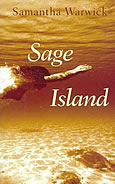 I’ve been writing this column for seven months and just realized an unconscious preference for sport-related books. Of the seven books I’ve reviewed, three have an athletic focus: Downhill Slide (skiing), King Leary (hockey), and Fatal Tide (adventure racing). Here, I follow this trend and recommend Sage Island, a novel that portrays the struggle of an Ocean Marathon swimmer. I’ve been writing this column for seven months and just realized an unconscious preference for sport-related books. Of the seven books I’ve reviewed, three have an athletic focus: Downhill Slide (skiing), King Leary (hockey), and Fatal Tide (adventure racing). Here, I follow this trend and recommend Sage Island, a novel that portrays the struggle of an Ocean Marathon swimmer.
Sage Island is set in the 1920s. Don’t, however, expect a Gatsby-esque milieu of flagrant excess, mass consumerism, and bored privilege. The protagonist of Sage Island, Savanna Mason, is not of that class. To the wealthy party-goers normally associated with flapper-era fiction, Savanna is no more than an amusing diversion to be summoned when convenient, put on display, and then ruthlessly dismissed when she no longer serves a purpose. Therefore, other than the references to prohibition and the occasional high-class party, Sage Island does not give us Fitzgerald’s 1920s. Instead, author Samantha Warwick recreates the era in terms of sport history. Sage Island paints in intricate detail an age when a pool was called “a chlorinated tank,” freestyle was called “the overhand crawl,” and an American woman could qualify for the Olympics in the 100 free with a 1:12 (a 1:12!!).
The novel follows the swimming career of Savanna Mason, who narrowly misses qualifying for the Paris Olympics and then decides, instead, to plunge into the challenge of marathon swimming. The first-person narrative places readers right in the murky depths of Mason’s psychological crisis. Interestingly, Mason’s obstacles do not manifest themselves as training challenges or physical shortcomings but as barriers created by sponsors, opponents, family, and friends.
We know we’re going to get a wonderfully poetic immersion into the body of the swimmer right from these opening lines: “That feeling when you first enter the water, straight as a needle; that underwater glide, the flying, weightless sensation of being suspended—free. You soar up to the surface and hit a rhythm, strike forward into a hypnotic swimming trance. This is where I feel right.” For Mason, swimming is the only way to “clear out everything, wipe the mind’s slate clear.” Throughout the novel, swimming is not an activity, but a place. It becomes a refuge for “dreamers and desperados” and as such is paralleled to novel-writing or any other activity that challenges the status quo and leads to a life unlikely to be accepted by more “practical creatures.”
Don Morrow, a UWO professor of sport literature, claims that no sport literature is really “about” sport, but that it attempts to express the human condition using sport as the dominant metaphor. Supporting Morrow’s claim, swimming in Sage Island reveals the human condition in ways that have nothing at all to do with the sport itself.
Just before the start of her Wrigley Ocean Marathon, Mason thinks: “I wonder if this whole event is fuelled by failures wanting to redeem themselves.” On one level, Sage Island is a novel about personal redemption. In the course of her crossing from Catalina Island to Los Angeles, Mason confronts what is worst in herself and exorcises it: “I must exhaust my former self, exhaust her out, exhaust all her fist-clenching rituals, exhaust the imprints—all that control I never had, the dread, the failures, the not-being good enough.” Through this physical exhaustion, Mason is reborn and tells readers: “I stroke onward, onward, crawling through the dark, with nothing but my newborn skin.” It may be that only she and “Loot,” the novel’s idiot savant, recognize her victory, but it is a victory nonetheless—Savanna Mason’s greatest one yet.
Sage Island is the story of an underdog overcoming adversity and winning, but the win is not the one we expect. Instead, we learn to redefine the very concept of victory—and the new definition is one that will appeal to “dreamers and desperados” of every era.
* * *
–
Angie Abdou is a local writer with two books to her credit and a third (a novel about ski bums) on its way. Angie will be teaching English 102 for university credit at the Fernie Campus of the College of the Rockies this winter. Call 250-423-4691 to register.
|