Running by Keith Maillard
– Reviewed by Angie Abdou for The Fernie Fix’s January 2009 Issue
Buy this book on Amazon.ca

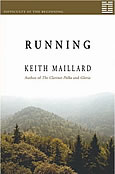 Recently, I spoke in Vancouver at an event dedicated to literary sport fiction. My co-speakers were Samantha Warwick (author of Sage Island) and Keith Maillard (author of Running). I bought Running that evening, read it on the plane home, and am now recommending it to you. Recently, I spoke in Vancouver at an event dedicated to literary sport fiction. My co-speakers were Samantha Warwick (author of Sage Island) and Keith Maillard (author of Running). I bought Running that evening, read it on the plane home, and am now recommending it to you.
Keith Maillard teaches creative writing at UBC, and he has, over the last thirty years, published fifteen books and won numerous literary awards, including the Ethel Wilson Fiction Prize for the best BC novel of the year. Running is the first book of a four-book series called Difficulty at the Beginning. This quartet follows the life of the fictional John Dupre, and Running can work as an introduction to the series or as a standalone novel.
On that evening in Vancouver, we spoke about the metaphorical potential of sport literature and the way in which a discussion of sports—or a description of the athlete in action—can have implications that extend far beyond the literal meaning. In my sport novel, The Bone Cage, a discussion of amateur sport becomes a consideration of the close ties between body and identity and of the ultimate impossibility of sustaining a self/body dichotomy. In Samantha Warwick’s sport novel, the discussion of marathon swimming becomes an assertion of the importance of following dreams that allow us to defy convention and to challenge society’s predetermined scripts. In Maillard’s novel, sport does not dominate the plot as much as it does in The Bone Cage or Sage Island, but understanding what the novel says about running is central to understanding what it says about life. In other words, in terms of theme and metaphor, sport is just as central to Running as it is to both Sage Island and The Bone Cage.
Running is a Bildungsroman, chronicling not only the coming-of-age of John Dupre but also the coming-of-age of a whole society in the transformational years of 1958-1960. John is an unconventional boy growing up in the all too conventional 1950s. Some of his earliest memories involve his wish to be a girl and his preference for girls’ clothing. He needs to “learn to be a boy” during an era that allows little flexibility in gender roles. As a teen, he joins the track team as part of his project of making himself “into a real boy.” In this quest for masculinity, he also takes up hard drinking and gets himself a girlfriend.
Throughout the novel and its account of John’s growth into a “Man,” he and his best friend Lyle Ledzinski dedicate themselves, as only the young can, to finding “the truth.” Interestingly, running is an important part of this pursuit. Even as teens, the two boys intuit that one must unite the physical, the mental, and the spiritual to arrive at their sought-after truth. As Lyle instructs John, “You’ve got to TRAIN HARD. That’s what you need. That’s where you’ll find it. Work. Suffering.” In this way, running becomes a religious experience: “It’s like a rosary [….] Every lap is a prayer.”
Maillard’s descriptions of the pain of running are wonderfully visceral. In the middle of a mile race, the narrator describes himself “panting through a mouthful of sand, lungs straining like toy balloons blown to the edge of bursting. Stomach full of ground glass, a knife in the side, and a dangerous twinge of nausea.” Only in this pain does John realize that, in essence, he is merely an animal fighting against dying. The same, of course, can be said of every human being. Always.
But that truth is only one of the truths revealed through sport and through Running. For such a slim novel, Running has a surprisingly wide scope. In only 152 pages, Maillard’s book captures an entire generation on the brink of momentous transformation. In this short space, John Dupre lives through many changes, including a reality-shifting revolution in society’s ideas about physicality, sexuality, and gender.
I haven’t yet read the other three books of Difficulty at the Beginning, but I’m intrigued. In fact, I predict that by the time you read this review, I’ll be sitting on a beach in Mexico deeply immersed in book four.
Happy New Year … and happy reading!
* * *
–
Angie Abdou is a local writer with two books to her credit and a third (a novel about ski bums) on its way.
|