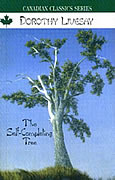
The Self-Completing Tree by Dorothy Livesay
– Reviewed by Angie Abdou for The Fernie Fix’s July 2008 Issue
Buy this book from Amazon.ca
 Fernie residents have no shortage of reasons to be proud of their home. Record-breaking snowfalls, breathtaking views, unbeatable fly-fishing, and an endless trail system top the Fernie Brag List. For those getting tired of the same old boasts, here’s a new reason to brag about our little community: our mayor is Dorothy Livesay’s grandson. Fernie residents have no shortage of reasons to be proud of their home. Record-breaking snowfalls, breathtaking views, unbeatable fly-fishing, and an endless trail system top the Fernie Brag List. For those getting tired of the same old boasts, here’s a new reason to brag about our little community: our mayor is Dorothy Livesay’s grandson.
For anyone who has studied Canadian Literature, the name “Dorothy Livesay” carries as much weight as “Margaret Atwood.” Livesay published more than twenty-five books. She won two Governor General’s Awards for Poetry. She taught at universities throughout the country. She published her first book of poetry (The Green Pitcher) at the age of nineteen and her last (The Woman I Am) at the age of eighty-two. A final book of her poems was published posthumously in 1998, two years after her death. In acknowledgment of her preeminent literary status in this province (and in this country), the annual prize for the best book of poetry published in British Columbia is called “The Dorothy Livesay Prize.”
Delving into Livesay’s large body of work can be intimidating. Fortunately, she undertook the task of sorting it for readers. The Self-Completing Tree is a collection of the poems that Livesay herself wanted to be remembered by. This book contains several of her most famous poems (“The Three Emilys,” “An Unquiet Bed,” “Bartok and the Geranium”) as well as a range of her lesser-anthologized works (a healthy selection of the Africa poems as well as several of her “documentary poems”). As such, The Self-Completing Tree functions as the perfect introduction to Livesay’s sprawling body of work.
First, put any clichéd notions of grandmotherly writing out of your head. You won’t find a woman in a flowered hat writing rhyming couplets to her cats here. Instead, you’ll find a woman rebelling against the demands of motherhood and critiquing our society’s rigid gender roles. Long before anyone had heard the terms “co-parenting” or “stay-at-home dad,” Livesay questioned the way in which women were expected to give up their careers for their children, while men maintained the same freedom they had before becoming fathers. She stressed that women ought not to lose themselves in marriage. She fought, in other words, to remain “Dorothy Livesay” rather than becoming “Mrs. Macnair.” A poetic rendition of this sentiment reads: “the woman I am/ is not what you see/ move over love/ make room for me.” Undertaking this battle as early as the 1950s, Livesay proved that she possessed not only a formidable literary talent but also the strength and independence-of-thought required of an influential social activist.
Most admirably, then, Livesay viewed writing not as a personal indulgence but a public act. For her, writing was a political tool and she used it to address inequalities in society. Through her poetry, she spoke out against injustices ranging from the Japanese internment camps to the mistreatment of the elderly to the privileging of heterosexuality. Anyone writing poems of political action in Canada today must give thanks to Dorothy Livesay for paving the way.
Academic writing on Livesay’s poetry attests to its political volatility and range. Scholarly interpretations of her work put it to the service of feminism, communism, homosexuality, and Lacanian psychoanalysis. Nonetheless, one does not need to invoke Lacan to understand or appreciate Livesay’s poems. Take, for example, these few lines from “Bartok and the Geranium”: “She’s daylight/ He is dark/ She’s heaven-held breath/ He storms and cackles/ Spits with hell’s own spark/ Yet in this room, this moment now/ These together breathe and be:/ She, essence of serenity,/ He in mad intensity.” On a single read, we can appreciate this passage for its precise diction, energetic syntax, vivid imagery, and engaging action. If we want to think further, we can ask ourselves: if Bartok represents Art and the Geranium represents Nature, what is Livesay saying about the relationship between Art and Nature? If we want to bend our minds further yet, we can ask: if Bartok represents men and the Geranium represents women, what point is the poem making about the war between the sexes? Next, if we’re the type of people who make our living analyzing and teaching Livesay’s work, we might invoke the feminist/ psychoanalytic theories of Julia Kristeva and talk about the ways the poem works to claim semantic space for women. In other words, The Self-Completing Tree (like all truly great literature) can be revisited many times and in many ways. We can approach the book in the pursuit of pure pleasure, in the quest for intellectual exercise, or in the hope of being motivated towards political action. The Self-Completing Tree fully delivers on all counts.
If you know Randal Macnair, you are just one degree of separation from Dorothy Livesay. That alone should be reason enough to check out her work. The fact that she’s a two-time recipient of the Governor General’s Award for Poetry and an Officer of the Order of Canada is an added bonus. For people who don’t have time to work their way through all twenty-five of Livesay’s books, The Self-Completing Tree is the perfect place to start.
* * *
– Angie Abdou is a Fernie writer. Her most recent work includes a short story collection called Anything Boys Can Do and a novel called The Bone Cage. She will be teaching Creative Writing 101 for university credit at the Fernie campus of College of the Rockies this fall.
|