Sport Lit for a Sporty Month: King Leary by Paul Quarrington
– Reviewed by Angie Abdou for The Fernie Fix’s August 2008 Issue
Buy this book from Amazon.ca
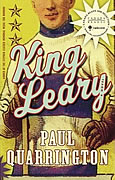 King Leary was written in 1987, but was recently (and deservedly) resurrected as the winner of CBC’s 2008 Canada Reads competition. Simply put, Paul Quarrington is nothing short of brilliant, and King Leary deserves a prominent place on every bookshelf. King Leary was written in 1987, but was recently (and deservedly) resurrected as the winner of CBC’s 2008 Canada Reads competition. Simply put, Paul Quarrington is nothing short of brilliant, and King Leary deserves a prominent place on every bookshelf.
Like all memorable novels, King Leary breaks rules at every turn. For one, it bursts right out of the traditional form of “sports novel.” Everyone is familiar with the standard sport-story narrative: underdog sets ambitious goal; underdog trains hard to achieve ambitious goal; underdog is rewarded with promising success en route to goal; underdog faces major obstacle (usually an injury, a break-up, or the death of a father figure); underdog contemplates quitting; underdog receives rallying pep-talk; underdog resumes the quest and (of course) wins championship. The standard sport story thus ends with the protagonist victorious and at the very peak of his (or, far less often, her) physical prowess.
Quarrington shatters this mold. His novel is narrated by Percival Leary (“King Leary”), a deluded and toothless old man remembering his hockey-legend status from the confines of an old-age home. Like many a sport legend, the place King Leary reigns most supreme is in his own memory. In other words, the person most impressed with Percival Leary’s physical prowess is none other than Percival Leary himself. And as the novel progresses, readers have increasing reason to suspect that Mr. Leary may not exactly be a reliable narrator. Time has warped Leary’s understanding of events, and (as readers eventually deduce) his perception of his own self-worth may have been none too clear to start with. He remembers himself as King of the Ice, best hockey player there ever was, but reading between the lines, we learn that his nick-name has more to do with his giant ego (“Who does he think he is, King of the Ice?”) than his impressive scoring stats.
The writing is delightfully experimental, sometimes slipping into the stream-of-consciousness of a senile old mind that has lost track of the differences between past, present, and future (and in King Leary’s case, the only future can be the after life). Ghosts inhabit the latter half of the book, so that the distinctions between real & imagined and significant & insignificant are increasingly blurred. Most importantly, readers begin to realize that perhaps these distinctions have been a bit blurry from the beginning. Perhaps, in fact, these distinctions are always blurred in the sporting life—a way of being that is by necessity inward focused, hubristic, and self-absorbed.
Leary, unsurprisingly, lives more in the past than in the present, and his past consists almost entirely of hockey memories. The amount of narrative he delegates to different parts of his life gives of a clear picture of his priorities. His father’s death takes place in a parenthetical aside, and he describes his wife’s beauty and virtues in a few understated sentences. On the other end of the spectrum, pages and pages are devoted to his own mastery of a particular hockey move. Tragically, Leary is oblivious to the problems this distorted perspective has caused (including the alienation of his children and even the death of those closest to him).
What, then, saves Percival Leary from being a despicable character and King Leary thereby being an unreadable book? Well, Percival Leary is really funny. People can get away with a lot when they’re really funny. Plus, by the conclusion of the novel, Leary has just enough of a hint of his own failures to make him a sympathetic character. In the end, perhaps it is the ideology of sport itself that is to blame for Leary’s short-comings as a husband, a friend, a father, and a human being.
King Leary is sport literature at its best – lively writing that indulges readers in some fast-paced action scenes while simultaneously prompting them to evaluate the very ideological underpinnings of sport culture. As we watch this year’s Olympics and dwell upon some of the lessons of King Leary, we may find that we mourn for the athletes as much as we celebrate them.
* * *
– Angie Abdou is a Fernie writer. Angie will be teaching Creative Writing 101 for university credit at the Fernie campus of College of the Rockies this fall. To register, call 250-423-4691.
|