Every Lost Country by Steven Heighton
– available at Polar Peek Books & Treasures in Fernie
– Reviewed by Angie Abdou for The Fernie Fix’s October 2010 Issue
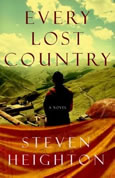 "Air this thin turns anyone into a mystic” – so starts Steven Heighton’s beautiful new novel, Every Lost Country. The book begins on a climbing expedition near the mountainous border between Tibet and Nepal, where altitude dulls the mind and “slurs the border between abstractions—right and wrong—or apparent opposites—dead and alive, past and present, you and him.” "Air this thin turns anyone into a mystic” – so starts Steven Heighton’s beautiful new novel, Every Lost Country. The book begins on a climbing expedition near the mountainous border between Tibet and Nepal, where altitude dulls the mind and “slurs the border between abstractions—right and wrong—or apparent opposites—dead and alive, past and present, you and him.”
The opening pages of Every Lost Country are based loosely on a 2006 conflict in which a Chinese border guard shot and killed a young Tibetan nun attempting to escape Chinese-occupied Tibet and cross the border into Nepal. At least two Tibetans were killed and several others wounded. The event became international news only because a European cameraman on a climbing expedition happened to video the violence and post it on the Internet. Allegedly, the expedition partners argued about whether they should ignore the event so that they could, instead, fulfill their own climbing goals. The rest of Heighton’s story and all of his characters are wholly invented, but that nugget of history provides the ethical and philosophical issues that permeate this action-packed account of Canadian climbers, Tibetan pilgrims, and Chinese border guards.
InHeighton’s imaginative leap from the 2006 conflict, Lewis Book, a member of Doctors Without Borders, has travelled to Nepal to join a climbing expedition led by Wade Lawson, who aims to be the first climber to summit Kyatruk. Book has brought his teenage daughter, Sophie, with him in hopes of rescuing her from troubles at home and strengthening their relationship, a relationship that has deteriorated with the breakdown of his marriage. Also playing a key role as the plot unfolds is Amaris, a Chinese-Canadian filmmaker recording the expedition (and, initially, sleeping with Lawson). Heighton skillfully weaves a complex narrative, telling and re-telling the story through the distinct lenses of these four main characters, all with their very own perceptions, preoccupations and biases.
When “Lew” really does ignore the border in order to fulfill his obligations as doctor, the climbing party is torn apart, and readers find themselves immersed in a terrifying and explosive pursuit. Every Lost Country is most unique in the way Heighton relays this suspenseful adventure with a poet’s touch. His finely crafted language will have readers lingering over sentences, coming back to admire their beauty, their resonance. Staying up late into the night fearing for the lives of these shockingly meaty characters – that I expected. True poetry in an action novel – that caught me pleasantly off guard.
Every Lost Country is remarkably quotable, exquisitely-phrased jewels of wisdom and truth on every page. Let me contain myself and just share my favourite line (or the line that occurs to me at this very instant as my favourite): “Desire is a narrative that keeps you moving forward, even at a crawl, needing to find out.” A description of romantic love, this sentence comes near the end of the novel, when readers are eager to reach the novel’s conclusion but also keen to remain in this heightened world for as long as possible. Every Lost Country thus confirms the assertion of Robert Scholes and Peter Brooks that a reader’s desire is not unlike a lover’s desire. Reading has its own erotic of pleasurable delay. Heighton gives the reader space to remain in this one sentence, pulling out layers of competing meanings, considering wide-reaching implications, admiring the density and complexity packed into just a few words. Clearly, even when Heighton writes novels, he’s still a poet.
And the characters in Every Lost Country are every bit as engaging as the language. Lew Book is especially intriguing, particularly in his desire to be good, to live up to the “doctors without borders” ideal, to never choose sides, to never judge, and to always do the right thing. I kept asking myself, why did Heighton name his protagonist Book? No novelist puts a “Book” in his work without carefully considered reasons. Lewis Book. Lew is Book. Perhaps, a man truly without borders—a man this good—can only exist in the thin-aired world of a novel.
Pick up Every Lost Country. Step into Heighton’s imaginary world. It will, at least for a time, turn you into a mystic too.
– Angie Abdou is a local writer with two books of fiction to her credit and one more on its way (The Canterbury Trail, March 2011, Brindle & Glass Press). For more information on Angie’s publications and upcoming speaking engagements, see this website.
|