Seeing Green: Wolf Tree by Alison Calder (Coteau Press)
– Reviewed for The Fernie Fix’s Green April 2008 Issue
Buy this book from Amazon.ca
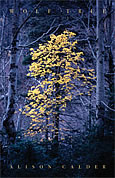 Alison Calder’s debut poetry collection, Wolf Tree, is infused with reverence for the natural world. Images of fishing and hiking capture nature with exactly the beauty, originality, and resonant truth that readers come to poetry to find. But Wolf Tree is no mere homage to the splendour of the outside world. Instead, the book continually surprises readers with its range, and at every turn of the page, we find startlingly new emotions, topics, and forms. This is a book filled with circus freaks and natural disaster, with quiet domestic love and equally quiet domestic chores. It is a book that alludes to Heidegger on one page and prairie cookbooks on another. Wolf Tree captures the world with such density and complexity that it bears up under—in fact, demands—multiple re-readings. Alison Calder’s debut poetry collection, Wolf Tree, is infused with reverence for the natural world. Images of fishing and hiking capture nature with exactly the beauty, originality, and resonant truth that readers come to poetry to find. But Wolf Tree is no mere homage to the splendour of the outside world. Instead, the book continually surprises readers with its range, and at every turn of the page, we find startlingly new emotions, topics, and forms. This is a book filled with circus freaks and natural disaster, with quiet domestic love and equally quiet domestic chores. It is a book that alludes to Heidegger on one page and prairie cookbooks on another. Wolf Tree captures the world with such density and complexity that it bears up under—in fact, demands—multiple re-readings.
Perhaps the most significant accomplishment from an ecological perspective is the way in which Calder forcefully breaks down the distinction between outside world and inside world, between human and nature, continually reminding us that we are a part of the natural world. She allows readers no safe, comfortable distance from nature. In the very first poem, we read of a person inhabited by a bird. The speaker adapts to the intrusion, to the fluttering behind her eyes, claiming: “Lately I’ve learned to see through wings.” But still, she can never achieve ultimate unity of self in opposition to nature, and the poem concludes: “Only the corner of my eye can give me away./ A small fluttering thing tries to get out.”
The tone of this collection is often dark. In “Imagine” readers are exposed to a variety of common tortures inflicted upon young women. The first lines read: “Imagine a picture of your sister or your daughter/ stretch it out. Do not stop pulling/ Stretch until the bones jut, until the body/ reveals the frame. Stretch until all you see/ are bones and eyes. This is a woman/ who sends herself to sleep by counting ribs.” The poem closes with a picture of another woman: “This is a woman/ who needs men’s hands to put her together./ At night she dreams herself naked on a stage./ In the orchestra there are one thousand mirrors./ All day she tries to remember her reflection./ At night she tries to reassemble herself.” In this world where we cannot even respect ourselves and each other, how can we be expected to respect the world in which we live?
This anger reaches its peak in a powerful piece called “We Hate the Animals.” Here, Calder astutely reveals humans’ greed and their sense of entitlement, their belief that they are superior to (and in control of) the world around them. For example, the speaker complains of animals attracted to human trash: “The blunted bears are at the dump tonight,/ drive in to watch incinerator greed./ Destroy them too. They are not real,/ not like us. We fight for life,/ we get and get and get. It’s ours.” Most impressively, Calder trusts her readers to recognize the danger of this way of thinking. She does not grant the speaker with a heavy-handed epiphany. She does not close the poem with a blatant moral statement for the reader. Instead, the closing lines read simply: “Oh how we hate the animals/ hate what we think we’ve made.” Any epiphany here must lie within the reader.
And, this collection does so much more than rail at human stupidity in the face of environmental disaster. Like all good poetry, Wolf Tree’s insight and beauty are much greater than can be captured in mere prose. For the glorious, ineffable full effect, you will have to read it yourselves. And then read it again.
* * *
– Angie Abdou is a Fernie writer. Her recent work includes a short-story collection called Anything Boys Can Do and a novel called The Bone Cage.
|