The Weekender Effect by Robert William Sandford
– Reviewed by Angie Abdou for The Fernie Fix’s February 2009 Issue
Buy this book on Amazon.ca

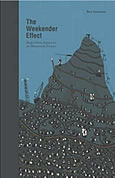 The Weekender Effect, a non-fictional treatise about the pitfalls of hyper-development in mountain towns, is essential reading for anyone with connections to a small mountain community. This very slim book (only 115 pages) was penned by Robert William Sandford, an internationally renowned cultural and ecological historian and a long-time Canmore resident. His central thesis is that it is not what we in Western Canada “have built that makes us truly unique as a culture, but what we have saved.” The book presents an argument against development (and for conservation) while emphasizing the important connection between place and identity. Sandford quotes many poets and philosophers including Wendell Berry who claimed that “you can’t know who you are unless you know where you are.” Sandford, therefore, encourages all mountain residents to decide what kind of community they want to live in (and what kind of community they want to preserve for their children) and then “fight to the death” against the evils of tacky highway strips, chain hotel/restaurant franchises, increased vehicle traffic, unaffordable housing, and all other indicators that we have lost what makes us unique. The subtle details which we may not adequately appreciate until they are gone are what many of us moved to the mountains for in the first place. In losing them, we will lose what makes our place special and will become just like everywhere else. The Weekender Effect, a non-fictional treatise about the pitfalls of hyper-development in mountain towns, is essential reading for anyone with connections to a small mountain community. This very slim book (only 115 pages) was penned by Robert William Sandford, an internationally renowned cultural and ecological historian and a long-time Canmore resident. His central thesis is that it is not what we in Western Canada “have built that makes us truly unique as a culture, but what we have saved.” The book presents an argument against development (and for conservation) while emphasizing the important connection between place and identity. Sandford quotes many poets and philosophers including Wendell Berry who claimed that “you can’t know who you are unless you know where you are.” Sandford, therefore, encourages all mountain residents to decide what kind of community they want to live in (and what kind of community they want to preserve for their children) and then “fight to the death” against the evils of tacky highway strips, chain hotel/restaurant franchises, increased vehicle traffic, unaffordable housing, and all other indicators that we have lost what makes us unique. The subtle details which we may not adequately appreciate until they are gone are what many of us moved to the mountains for in the first place. In losing them, we will lose what makes our place special and will become just like everywhere else.
Sandford’s passion for this topic arises out of his dismay at what Canmore has become. “Where I live,” he writes, “it will take time and vision to make a true home and a real community out of what has essentially been for decades an enormous construction site.” He outlines four specific ways in which the quality of life in Canmore has been negatively affected by development that happened too quickly and without adequate influence from “insiders.” First, traffic has increased to the extent that there are times of the day when it is difficult to get around: “If you came from a city, you wouldn’t notice. But I do. I don’t want to live in a city.” Second, the increased traffic lights have brought about a “regulated pace of life” previously avoided in mountain towns: “Not long ago we used to be able to stop even in the middle of Main Street to greet one another. Do that now and someone will lay on the horn until you move.” Third, common spaces have nearly all been replaced by private land. Finally, Canmore is no longer a town where most locals know each other. Before “People stopped and talked everywhere they met. It was possible to go to the grocery story or the post office and know everyone.” Now, Canmore has the “namelessness and facelessness of a city.”
Anyone who loves Fernie may be hearing some alarm bells here. The Canmore-of-old that Sandmore describes with such nostalgia (and mourns with such heartfelt grief) sounds a lot like the Fernie of today. His complaint is that instead of staying and protecting such places, residents simply run away from the hyper-development and escape to the next pristine mountain setting. Here, he mentions Fernie: “Now that the town I live in has changed, people who seek place are looking at Golden in British Columbia. People in Golden are looking at Fernie and Nelson. The people in Nelson are looking to the Slocan. The people in the Slocan Valley have no place else to go.”
What, then, is to be done? In setting forth a course for future action, Sandmore explicitly praises our political leader Randall MacNair because he has encouraged “people who start as weekenders to become full-time locals” and to contribute to the community by staying here “with the proper aim of building on the good that is already present rather than replacing it with what they sought to escape where they used to live.”
Clearly, this book’s issues are relevant to all residents of Fernie. However, I recommend it with reservations. First, I’m wary of Sandford’s repeated use of “we” when he talks of creating the West that “we want.” Who is this unified “we”? Who gets to decide what our towns should be? He claims that “What we [italics mine] experienced was outright dispossession. Locals, like the First Nations before us, have been made refugees in their own land.” Is this our own land? The comparison to First Nations seems nothing short of absurd (not to mention offensive). Also, Sandford’s frequent (and overly-simplified) use of the word “locals” highlights a lack of subtlety. Anyone who has lived in Fernie for more than a few weeks knows that “local” is a slippery term and who has rights to it varies depending on who you ask. Sandford’s argument depends upon an easy dichotomy between the evil “outsiders” (developers, real estate agents, and “wealthy urbanites”) and the good “insiders” (“we” “locals”). It’s a dichotomy that doesn’t capture the complexity—or the shades of grey—that I’ve observed in my own mountain town.
Finally, I found myself craving footnotes and a bibliography. Simply put, Sandford makes too many unsupported claims. For example, he states that as a mountain community grows, long-time residents no longer feel they belong; the population goes up but “locals” are pushed out. It’s not that I disagree with him. In fact, on any given day the majority of customers sitting in Freshies may agree with him. But when I read a published book, I like to be provided with evidence and statistics to support my un-researched suspicions. Too often, this book doesn’t have them.
These reservations can all be attributed to the book’s slimness. The Weekender Effect is a book that you need to talk back to. It starts an important conversation but leaves it for mountain residents to finish. Read The Weekender Effect, but read it with a pen in your hand. Fill the margins with responses and questions. Then carry the conversations into the streets of Fernie. They are conversations that we (anyone with an interest in Fernie’s future) need to have.
* * *
Angie Abdou is a local writer with two books to her credit and a third (a novel about mountain culture) on its way.
|