Swimming by Nicola Keegan
– available at Polar Peek Books & Treasures in Fernie
– Reviewed by Angie Abdou for The Fernie Fix’s June 2010 Issue
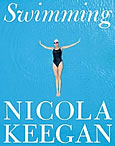 I could write a whole book chronicling my cognitive and emotional responses to Nicola Keegan’s Swimming. Don’t worry, though. I won’t. I will tell you, however, that I came to this novel with great trepidation. Some readers might know that I wrote a novel featuring a female Olympic swimmer and exploring themes such as the relationship between body and identity, the challenge of post-Olympic depression, and the attempt to find meaning through sport. Nicola Keegan’s Swimming is a novel featuring a female Olympic swimmer and exploring themes such as the relationship between body and identity, the challenge of post-Olympic depression, and the attempt to find meaning through sport. I could write a whole book chronicling my cognitive and emotional responses to Nicola Keegan’s Swimming. Don’t worry, though. I won’t. I will tell you, however, that I came to this novel with great trepidation. Some readers might know that I wrote a novel featuring a female Olympic swimmer and exploring themes such as the relationship between body and identity, the challenge of post-Olympic depression, and the attempt to find meaning through sport. Nicola Keegan’s Swimming is a novel featuring a female Olympic swimmer and exploring themes such as the relationship between body and identity, the challenge of post-Olympic depression, and the attempt to find meaning through sport.
You can see the problem here. Keegan didn’t stand a chance with me. If her book was better than mine, I’d be jealous and hate her. If her book was worse than mine, I’d be annoyed that she got a review in stupid Oprah’s stupid magazine, and I’d hate her. Nothing ruins reading quite like being a writer does.
However, after several months of mental coaching, I was able to get over my own ego and spend some time with Keegan’s novel. I loved it. Keegan takes impressive risks with style, structure, and characterization. There were many points when I thought this will never work.
The point of view is too internal, said my skeptical self, the structure too episodic, the language too densely poetic for a long novel. However, as I suspended my judgment and fell in-love with the wildly screwed-up main character Pip, the oddest thing happened: Swimming worked. Absolutely. Moreover, because Keegan takes these risks, her novel is utterly original, and because the narrative is rooted so deep – even so claustrophobically – in Pip’s consciousness, we feel her struggles as though they are our own. The account of Pip’s rise (and fall) as an Olympic Champion has much greater impact than a less inventive style would have allowed. The experience of dwelling right in Pip’s subconscious mind through her post-athletic breakdown is not always pleasant or easy, but it’s immensely powerful.
Because Keegan portrays the swimming life (and the crazed-intensity of retiring from swimming) so believably and with such emotional weight, I felt sure that she herself had swum competitively. However, after some cyber-stalking, I learned that Keegan is not a swimmer at all (chlorine hurts her eyes). Instead, Keegan came to the topic after discovering the prevalence of water imagery in her poetry and learning that water functions as a metaphor for the subconscious. Keegan built upon this realization in her debut novel, using swimming to explore death, neuroses, heartbreak, obsession, hunger, family, psychoanalysis, competition, dysfunction, love, truth—life.
Pip’s mean-spirited sister Dot articulates the question at the heart of the novel: “People are killing each other every second, children are starving, kids graduate from high school and don’t know how to read, the ocean’s full of garbage, the world’s off-kilter, heading toward certain ecological disaster, life’s a big piece of shit, and all you think about is swimming. Swimming.” Why does swimming matter? For that matter, why does anything matter? Ultimately, Keegan’s novel is, like much great literature, about how to find meaning in an individual life.
Nicola Keegan, in other words, takes swimming and transforms it into much more. In her deft hands, a flip turn becomes a complex and beautiful metaphor for life. As an English teacher, a writer and an ex-swimmer, I have one response to that: AWESOME!
Copyright © 2010 by Angie Abdou, Ph.D.
–
Angie Abdou
is a local fiction writer. This month she travels to the annual Sport Literature Association conference in Pennsylvania to deliver a paper called “Sport as Subversive Space in Three Contemporary Swimming Novels.” For more information on Angie’s publications and upcoming speaking engagements, see this website.
|