The Good Body by Bill Gaston
– out of print but available at a library near you
or buy online at Amazon.ca
– Reviewed by Angie Abdou for The Fernie Fix’s June 2009 Issue
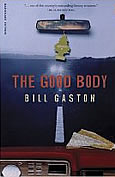
Hooray! I found a new book to love. That’s one of my favourite things – stumbling across an old book, which I entirely missed on its initial release, and discovering that it’s engaging, funny, profound, important, beautiful and utterly mesmerizing. In terms of theme and style, The Good Body is most similar to Paul Quarrington’s King Leary, and anyone who remembers my column on King Leary will read this as the highest of praise.
The Good Body is about Bobby Bonaduce, a retired hockey player recently diagnosed with Multiple Sclerosis. Facing his imminent death, he returns to the Maritimes in an attempt to create a relationship with his estranged son, Jason Bonaduce. His plan (misguided at best) is to cheat his way into grad school, gain athletic eligibility, try out for the varsity team, and then play hockey side-by-side with his long-lost son. This convoluted course of action has one ultimate goal: to create the opportunity for father and son to smack each other across the ass, which is—as any aficionado of sporting culture knows—the height of male bonding.
The novel’s scenario (ex-goon returns to university as a Creative Writing major) gives Gaston plenty of material for satire. The grad school scenes are hysterically funny. Bonaduce finds himself in a new world with a new language. As an intimidated outsider, Bonaduce’s main coping mechanism is a healthy sense of humour. Throughout the semester, he jots down phrases he might use in his year-end seminar: “delicate with parody,” “gently hyperbolized diction,” “rife with serious play.” As a student of literature myself, I couldn’t decide whether to laugh or to copy the phrases out for my next academic essay. In one seminar, Bonaduce’s classmate begins his presentation with this sentence: “Now of course the temptation is to foreground a reading of Volcano with a reading of Lowry’s life, but those narrative contrivances in the text—linearity, closure, what have you—subsume in their very artifice, artifice by which the text, as a ‘novel,’ derives, shall we say…” Reading this scene aloud to my husband, I could hardly enunciate the words though my laughter. My husband looked confused: “But isn’t he making fun of … well … you?!” Exactly. A writer has to be spectacularly good to get readers to genuinely laugh at themselves. Gaston’s that good.
And the sports scenes are just as funny. There are the standard Leafs’ jokes (isn’t that Canadian culture at its best, mockery of the Toronto Maple Leafs uniting our citizens from coast to coast). But there are also more complex uses of comedy. Gaston draws us into the scene with humour, but then we suddenly find ourselves peering through the joke and considering some of the most difficult issues of human existence, questions of what makes a life worthwhile, what gives a person’s actions meaning.
The novel is at its most profound in its statements on the mind/body dichotomy. Initially, there are “body people” (e.g. hockey players) and there are “mind people” (e.g. English grad students). Bonaduce is being forced to transition from one to the other. As his body shuts down, plaque building up through his central nervous system, he works to sharpen his mind. By the novel’s conclusion, he is all mind and no body. But having a sharp mind does not mean he has mastered and adopted the discourse of graduate school. His brand of “smarts” is more original than that At the start of the novel, he tells us that there are different kinds of intelligence; by the end of the novel, we believe him.
Kurt Vonnegut has argued that laughing and crying are essentially the same response; both are the body’s reaction to absolute grief or utter despair. You laugh (or you cry) when there is nothing else to do. When filled with emotion so strong it cannot be articulated, the body expels that emotion as tears (or laughter). The Good Body supports Vonnegut’s argument. This book will make you both laugh and cry, sometimes on the same page, sometimes in the same sentence. I could (truthfully) tell you that the book continually made me laugh aloud, but that would trivialize the material. This book is not light comedy; rather, it makes deeply profound statements on the meaning of human existence. But the narrative is so dense, so multilayered, that it somehow manages to poke fun of itself the whole time that it’s dealing with particularly unfunny subjects. In Gaston’s skillful hands, even death can get a laugh or two. The Good Body is, in other words, “rife with serious play.” (Wait a second, there’s also “gently hyperbolized diction” and it’s “delicate with parody.” I smell metafiction, says my geeky Perpetual Grad Student self. Gaston only satirizes that of which he’s master).
Bobby Bonaduce, absurd and pathetic as he can be, is making a valiant, admirable effort to revise his life, to undo his mistakes. The reason he’s suddenly working so hard to repair broken relationships and to make his life meaningful is, of course, that he is dying. Through the course of the narrative, though, Gaston gently reminds us that we are all dying. To himself, Bonaduce articulates this revelation in terms of a hockey metaphor: “We’re alive, so we’re in their arena, we’re really just waiting. He thought about death and saw that being alive in the first place was sort of like asking for it.”
It’s enough to make you cry. Or laugh.
– Angie Abdou is a local writer. For more information on her publications and upcoming speaking engagements, see this website.
|