Georges Laraque with Pierre Thibeault
– Originally written for (and posted in) the Sport Literature Association’s book review data base by Angie Abdou
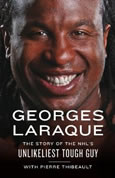 I first met Georges Laraque in extraordinary circumstances: he was a celebrity debater for the Canadian Broadcasting Corporation’s nationwide book contest called Canada Reads, and he chose to defend my first novel, The Bone Cage. Clearly, I’m predisposed to like him and his book: he gave my writing career a boost for which I will always be grateful. I first met Georges Laraque in extraordinary circumstances: he was a celebrity debater for the Canadian Broadcasting Corporation’s nationwide book contest called Canada Reads, and he chose to defend my first novel, The Bone Cage. Clearly, I’m predisposed to like him and his book: he gave my writing career a boost for which I will always be grateful.
Before I met Georges Laraque, I was aware of him through reputation and image. I had seen BGL (Big Georges Laraque) in the media and on the rink so often that I thought I more or less knew him: big, tough, and mean. Block caps for each. He was, in my mind, a man fully defined by his gargantuan stature and how he used it against others.
But then I met Georges, and I realized the deceptive nature of celebrity, lulling viewers into a false sense that they know a whole person when all they know is an illusion that has been deliberately packaged and sold to them. I was ashamed of how passively I had accepted this image the media handed me, an image based on the most reductive and simplistic of stereotypes. The thing about real people, as opposed to celebrity personalities, is that they are complex and full of contradictions. In reality, Georges Laraque—oft labeled “the best fighter” “the #1 enforcer” and “the toughest guy in the league”—is a soft-spoken and gentle soul, a vegan who advocates for animal rights and a humanitarian who devotes countless hours and seemingly limitless energy to causes ranging from sick kids, to environmental collapse, to gay rights, to disaster relief. On the first day we met, Georges told me a story about searching for the perfect pair of synthetic gloves so that he could avoid the heartless savagery of wearing animal skin, and I wondered: where is the blood-thirsty Neanderthal I’ve seen on my TV and in the pages of my newspaper?
Of course, there is an interesting contradiction in the story of BGL’s gloves. Laraque went to great lengths to find good synthetic gloves so that no animals would be hurt for the sake of protecting his hands, but he then dropped those same gloves to punch fellow humans in the face. The pull between these two contradictory forces – one internal and one, partly but not wholly, external — is the heart of his captivating memoir. In the epilogue, he expresses surprise and pride that the Canadian-Tibet Committee members chose him to host the Dalai Lama in 2011 because they saw him as “an activist, not a pugilist” (338). The thorny question addressed in the rest of the memoir is how he has, throughout his life, been both a fighter and a humanitarian, simultaneously.
The Unlikeliest Tough Guy is timely in the wake of the deaths of three of the NHL’s tough guys: Derek Boogaard, Rick Rypien, and Wade Balak. Laraque does not shy away from sensitive discussions arising from these deaths. He expresses his condolences to the families of the deceased and then forges on to discuss the role of enforcers in the game and the challenges they face once their NHL careers end. In person and on the page, Laraque is startlingly honest. He never seems to worry about what he should (or, more to the point, shouldn’t) say; instead he simply and directly states exactly what he thinks. The unique offspring of that marriage between simplicity and candor is a memoir devoid of posturing. In a culture of canned media clichés, this honesty is refreshing, but more importantly it has the potential of leading to the kinds of open and informed conversations that hockey devotees need to be having in the aftermath of the sport’s tragedies.
Georges Laraque’s memoir, however, is about much more than hockey. He writes candidly about the immigrant experience, parenting, media, sport as entertainment, corruption in aid organizations, vertical farming, racism, fame as vehicle to effect positive change, and the pursuit of dreams (not an exhaustive list). It is disappointing, therefore, that the media has grabbed onto two barely significant parts of the book. Public conversation has centered almost solely on Laraque’s alleged “trashing” of Wayne Gretzky and his accusation of steroid abuse amongst hockey players. First, the discussion of both Wayne Gretzky and steroid-use combined accounts for less than ten pages of a nearly four-hundred page book. Second, Laraque does not trash Wayne Gretzky. He expresses a great deal of admiration for Gretzky as a player and a person. His only criticism of Gretzky is professional rather than personal. He claims that Gretzky is “the worst coach” he has “ever played for” (192), and he spends a little over one page explaining why. The way in which the media has latched onto this criticism, and taken it out of context, stands as proof of nearly every disparagement Laraque has leveled against reporters. Their response to the book and to Laraque is reductive, reactionary, lazy, sensationalized, and ill-informed.
Predictably, The Unlikeliest Tough Guy is now selling out across Canada to hockey fans lured in by the controversy. Those fans will be surprised to discover how off-the-mark the media circus around this release has been, but they will not be disappointed by the book itself. Laraque, with his distinctive voice and pervasive humour, is a born storyteller, and his book reads like an intimate conversation. In fact, that is exactly what it is, constructed out of over fifty hours of audiotape. In that respect, this memoir offers fans the treat of intimacy, like a friend telling in-jokes and sharing locker room stories. For academics, The Unlikeliest Tough Guy is an invaluable primary source. In a time when scholars of sport are thinking deeply about athletic violence, The Unlikeliest Tough Guy takes readers into the mind of a professional athlete who knows that violence from the inside.
Laraque, Georges. Georges Laraque: The Story of the NHL’s Unlikeliest Tough Guy. Toronto: Penguin Canada, 2011. 346 pages. Hardcover. $32.00.
Copyright © 2011 by Angie Abdou |