Earth After Rain by Sheri Benning
– Reviewed by Angie Abdou for The Fernie Fix’s April 2009 Issue
Buy this book on Amazon.ca

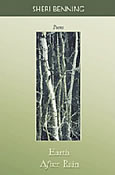 For last year’s Green Issue of The Fix, I recommended a book of poetry by prairie writer Alison Calder. This year, I’m recommending another book of poetry by another prairie writer. Earth After Rain, Sheri Benning’s first book, was published in 2001 and won two Saskatchewan Book Awards. Impressively, Benning was only twenty-four at the time. She has since been awarded the Lieutenant Governor’s “30 Below” Award that recognizes new and developing writers with exceptional promise. For last year’s Green Issue of The Fix, I recommended a book of poetry by prairie writer Alison Calder. This year, I’m recommending another book of poetry by another prairie writer. Earth After Rain, Sheri Benning’s first book, was published in 2001 and won two Saskatchewan Book Awards. Impressively, Benning was only twenty-four at the time. She has since been awarded the Lieutenant Governor’s “30 Below” Award that recognizes new and developing writers with exceptional promise.
Earth After Rain celebrates nature, but it is not sentimental or trite in any way. Benning’s nature inspires awe, but it also inspires fear and despair and leads to startling original ways of understanding humanity. Benning’s imagery is stark and violent. The moon is “a skeletal heart/ veined with glyptic/ messages” and the setting sun “a throbbing heart contained/ by fine cage of rib clouds.” Benning’s verbs are fierce. The sun “pounds” and “bruises.” A crow-breath before rain “punches” the earth, penetrating the human consciousness with “a beauty/ so sharp that/ when it enters/ it never leaves.”
Do not, then, expect comfortable and reassuring nature poetry that places the writer and reader outside of nature, admiring its beauty at a distance. Instead, Benning’s work allows no easy distinction between humans and nature. We are, whether we like it or not, part of nature. The persona in the first poem claims “my body is land—/ belly a pasture for grazing,/ feral earth between thighs.” Later in the collection, an ear placed on a lover’s chest hears “ocean sounds of blood.”
These poems dismantle the hierarchical relationship between humans and nature. Earth After Rain continually reminds us that we are not superior to the natural world, responsible for controlling and protecting it. Instead, we must learn from it. One speaker fearing childbirth looks to the bear as a source of education: “Bear, you teach me birth, your name a verb.” Other poems feature personas learning of death, vulnerability, and human weakness. John Fitzgerald Kennedy claimed that “when power leads man towards arrogance, poetry reminds him of his limitations.” Benning’s poems meet this criterion, continually reminding us of our own frailty and inferiority.
Wallace Stevens once wrote that “a poet looks at the world the way a man looks at a woman.”
For Benning, this is true if the man looks not just with lust and passion but also with precisely articulated fear and reverence, with the wisdom of a prophet, the insight of a spiritual guru, and the beautiful expression of a true poet.
Don’t simply read Earth After Rain. Savour it. Let it live in your head for awhile. Each poem will force you to see the natural world—and your place in it—with new eyes.
* * *
–
Angie Abdou is a local writer who has two published books (Anything Boys Can Do and The Bone Cage) and two beautiful children (Oliver and Katherine).
|