The Book of Stanley by Todd Babiak
– Reviewed by Angie Abdou for The Fernie Fix’s June 2008 Issue
Buy this book from Amazon.ca
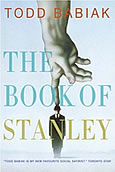 Before picking up The Book of Stanley, readers should prepare themselves for a surreal trip. In terms of genre, Babiak’s novel falls under the umbrella of Magic Realism and is thus in the company of Canadian works such as Yann Martel’s Life of Pi and Timothy Findley’s Not Wanted on the Voyage. In other words, readers hung-up on realism—readers who believe that art must imitate life—needn’t waste their time opening the front cover of Todd Babiak’s new novel. Fiction writers have the luxury of being unrestricted by tedious concerns of what has happened or what could happen. Anything can happen in fiction, and The Book of Stanley takes full advantage of this free reign. Babiak, like Findley and Martel before him, delights in exercising his imagination, pulling and pushing it to its outermost reaches. He challenges himself and in so doing he challenges his readers. Before picking up The Book of Stanley, readers should prepare themselves for a surreal trip. In terms of genre, Babiak’s novel falls under the umbrella of Magic Realism and is thus in the company of Canadian works such as Yann Martel’s Life of Pi and Timothy Findley’s Not Wanted on the Voyage. In other words, readers hung-up on realism—readers who believe that art must imitate life—needn’t waste their time opening the front cover of Todd Babiak’s new novel. Fiction writers have the luxury of being unrestricted by tedious concerns of what has happened or what could happen. Anything can happen in fiction, and The Book of Stanley takes full advantage of this free reign. Babiak, like Findley and Martel before him, delights in exercising his imagination, pulling and pushing it to its outermost reaches. He challenges himself and in so doing he challenges his readers.
At the start of this book, Stanley is an ordinary retired Albertan waiting out the end of his days in such acute boredom that he painfully notes every movement of his clock’s minute hand. In the opening scene, the setting sun (a clichéd metaphor for the end of life) casts a light that exposes every flawed detail of his house and his existence. Stanley’s only excitement lies in waiting to hear from his busy and successful son, who promises he will phone but never does. Impressively, Babiak manages to create humour around this protagonist who, with great apathy, is dying of cancer (only slightly faster than he is dying of boredom).
One example of Babiak’s dark humour comes when Stanley’s wife Frieda suggests that he e-mail his son this message: “Dear Charles. Hello, how is your money doing? Good? Good. So, remember that shortness of breath I mentioned? Turns out I have advanced cancer. I wanted to tell you over the phone but you’re too busy to call us back. [….] I’m dying. Love, Dad.” Frieda complains of their son’s self-absorbed nature, stating “we should have given him up for adoption. Or fed him to jackals at birth.” But rather than mope about their selfish son or about Stanley’s impending death, she suggests that they order Korean food and drink champagne until they pass out.
Babiak proves that even the morbid and mundane details of death can, in the right author’s hands, be pretty funny stuff. The Book of Stanley somehow manages to find comedy (albeit black comedy) in the least funny of situations. Reading the first pages, one cannot help but wonder if Babiak will be able to sustain this humour for an entire novel. However, readers never find out because on page eight, Stanley’s life is changed in the most dramatic of ways. The proverbial bolt of lightening—“a flash, a voice. A rumble.”—turns Stanley into a new person. His first changes include hyperawareness of the world around him, irresistible magnetism, and superhuman strength, but the special powers keep coming until Stanley—a lifelong agnostic—begins to be hailed as the New Messiah. Eventually, followers form a church in his honour; it is called The Stanley and is located, of course, in the Canadian Mecca that is Banff. The book, then, is (in part) religious satire, again falling into a category with Martel and Findley. But whereas in Martel’s work a discussion of religion is synonymous with a discussion of story-telling, for Babiak a consideration of religion goes hand-in-hand with a consideration of marketing.
Babiak, though, is not as philosophically probing as Martel or as darkly critical as Findley. In terms of the tone (glib, clever, sarcastic, fairly light), The Book of Stanley has more in common with the dysfunctional-family comedies of Douglas Coupland (All Familes Are Psychotic) and Mark Haddon (A Spot of Bother), and its representation of religion and contemporary society is quite similar to Will Ferguson’s Generica (i.e. laugh-aloud funny). In this way, The Book of Stanley is light enough—and, in the end, optimistic enough—to qualify as a pleasure-read at the beach, a prerequisite for any good summer-reading recommendation.
* * *
– Angie Abdou is a Fernie writer. Her recent work includes a short-story collection called Anything Boys Can Do and a novel called The Bone Cage.
|